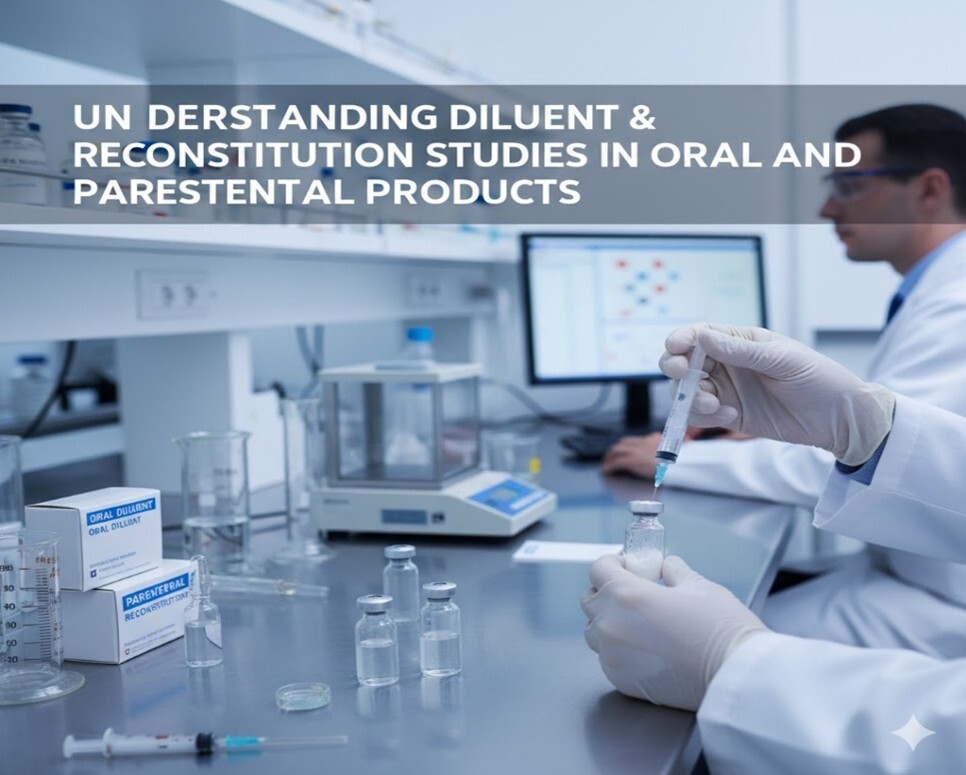
In pharmaceutical development, diluent and reconstitution studies play a crucial role in ensuring product quality, stability, and patient safety — especially for lyophilized powders, dry syrups, and oral powders for reconstitution.
These studies bridge the gap between formulation science and clinical usability — ensuring that once the powder meets its diluent, the final product remains safe, potent, and stable through its intended shelf-life and usage period.
- Applicable to lyophilized parenterals, dry syrups (oral powders), and powders for injection or infusion.
- Ensures compatibility, stability, and performance of the reconstituted or diluted product.
- Covers diluent selection, volume, reconstitution method, in-use stability, and container closure compatibility.
- Required for regulatory submissions (NDA, ANDA, MA, etc.) and product lifecycle management.
🎯 Objectives
- To establish optimal diluent type and volume for reconstitution.
- To verify stability and potency of the reconstituted solution/suspension over time.
- To assess pH, appearance, clarity, particulate matter, assay, and microbial integrity post-reconstitution.
- To define in-use shelf life and storage conditions after reconstitution.
- To ensure label instructions (e.g., “reconstitute with sterile water for injection”) are scientifically justified.
🧪 Procedure Overview
Step | Activity | Key Points |
1. Diluent Selection | Identify suitable diluents (SWFI, Bacteriostatic Water, 0.9% NaCl, Oral vehicle) | Based on formulation compatibility, route of admin, pH, and tonicity |
2. Reconstitution Volume Optimization | Determine required volume for target concentration | Consider dose uniformity and container headspace |
3. Reconstitution Process Evaluation | Observe time to dissolve/suspend, clarity, foaming, caking | Record visual parameters |
4. Stability Testing (Reconstituted State) | Store at recommended conditions and test at intervals | Analyze physical, chemical, and microbiological stability |
5. Analytical Testing | Perform assay, related substances, pH, appearance, particulates, reconstitution time, microbial limit | Use validated methods |
6. Data Interpretation | Establish in-use shelf life | Define label instructions accordingly |
⏱️ Test Conditions
- Storage:
- Room Temperature (25°C ± 2°C / 60% RH)
- Refrigerated (2–8°C)
- Accelerated (40°C ± 2°C / 75% RH) – as supportive condition
- Duration:
- Typically 0, 4, 8, 12, and 24 hours (for parenterals)
- Up to 7–14 days (for oral reconstituted suspensions)
- Containers:
- Primary packaging as marketed (vial, bottle, etc.)
- Closed between samplings to simulate patient use
⚗️ Analytical Parameters
Parameter | Purpose | Typical Method |
Appearance | Detect color change, precipitation, caking | Visual |
pH | Indicator of degradation or incompatibility | pH meter |
Assay / Potency | Ensure drug strength after reconstitution | HPLC/UV |
Degradation Products | Identify impurities post-reconstitution | HPLC |
Particulate Matter (Parenterals) | Ensure safety for injection | Light obscuration |
Microbial Limits | Check sterility (parenterals) or microbial growth (oral) | Plate count / Sterility test |
Reconstitution Time | Ease of reconstitution | Manual observation / stopwatch |
💬 Example Product Scenarios
Product Type | Example | Typical Diluent | Reconstitution Shelf-Life |
Parenteral Lyophilized | Ceftriaxone injection | Sterile Water / 0.9% NaCl | 24 hrs at 2–8°C |
Parenteral Biologic | Monoclonal antibody | Manufacturer-specified buffer | 7 days at 2–8°C |
Oral Powder for Suspension | Amoxicillin Clavulanate dry syrup | Purified Water | 7 days at 2–8°C |
Cytotoxic Injection | Lyophilized Paclitaxel | Special solvent + infusion diluent | 24 hrs at 25°C |
Paediatric Dry Syrup | Azithromycin powder | Purified Water | 5 days at 25°C |
🧭 Outcome
- Scientifically justified diluent and volume selection
- Defined in-use shelf life and storage post-reconstitution
- Ensured product safety, potency, and compliance
- Supported label claim and instructions for use
- Demonstrated regulatory compliance (ICH Q1A, Q1B, Q5C, USP <71>, <85>, <788>)
🧠 Key Takeaway
“A stable formulation is only half the story. How it behaves after meeting its diluent decides whether it performs safely in real life.”
Understanding and performing diluent and reconstitution studies is not just a regulatory formality — it’s a scientific responsibility ensuring patient safety and product reliability.